Inter Species Wisdom Project Inc. (ISWP) – a BC Benefit Company intelligencecommons.ca · hearings@intelligencecommons.ca
© 2026 Inter Species Wisdom Project Inc. All rights reserved. This document and its figures are published as a PUBLIC DEFENSIVE DISCLOSURE. First published August 2026 at intelligencecommons.ca. The concepts, combinations, and architectures disclosed here – in particular the claims enumerated in Section 12 – are placed on the public record as prior art, with a dated, versioned publication history. Copyright in the text and figures subsists automatically from creation.
Version history
| Version | Date | Change |
|---|---|---|
| v0 | May 12, 2026 | Pod Prototype Design (internal) |
| v1 | Jul 30, 2026 | Technical Blueprint (13 pp., circulated) |
| v2 | Aug 13, 2026 | Consolidated master: blueprint + 2026 technology market scan + pod detail + claims register + new figure set (Figs. 1-4). First public defensive-disclosure edition. |
Status. Concept-level blueprint and technology scan – not a stamped engineering design or construction specification. Every power, thermal, cost, water-output, environmental and reliability figure is a design-intent input to a funded feasibility study, and is validated there, not here. Figures in this state are marked pilot-gated.
1. The data centre dilemma – and the obvious answer

Every new data centre takes two things from its host community: power and water. The industry’s response to its heat problem is to throw the heat away – to the sky through cooling towers on land, or to the sea from the submerged data centres that already exist.
Submerged compute itself is proven. Microsoft’s Project Natick ran 864 servers sealed in nitrogen on the seabed for two years at one-eighth the failure rate of the equivalent land deployment (0.7% vs 5.9%), and China’s Highlander/Hailanyun installations have run commercially since 2023. Both dump their waste heat into the ocean. Neither returns anything to the coast that hosts them.
The Hub inverts the extraction. It is a community-owned marine microgrid with submerged compute as its anchor customer: a modular low-flow tidal array powers sealed seabed compute pods; the pods’ waste heat – the thing everyone else discards – drives membrane distillation and becomes the host community’s fresh water; surplus power exports to shore; and the host First Nation owns the Hub, is paid first off the top, holds an environmental veto, and can read every watt, litre and sensor on a public ledger. ISWP is the developer and holds no shares.
A data centre that makes power, makes water, and is owned by the coast it sits on – that is the answer, and once seen it is obvious.
2. The canonical numbers (one truth, every asset cites it)
All ISWP Hub materials – documents, figures, films, web pages – draw from this block. Where an older asset disagrees, this block wins.
| Parameter | Concept design basis | Status |
|---|---|---|
| IT load per pod | ~250 kW | pilot-gated |
| Total draw per pod | ~263 kW at PUE ≈ 1.05 | pilot-gated |
| Scale steps | 1 / 5 / 20 pods = 0.26 / 1.31 / 5.25 MW | design intent |
| Recoverable heat | ≈ IT load per pod | pilot-gated |
| Tidal resource band | 1.5-2.5 m/s – low-flow device classes required | site survey gates all |
| Desalination yield | membrane distillation, 3-4 L/kWh-thermal design margin (multi-effect upside higher; RO fallback carried) | pilot-gated |
| Cluster fresh-water output | up to ~50,000 L/day per 5-pod cluster | preliminary, pilot-gated |
| Cooling sink | 8-12 °C BC coastal water, year-round | published data |
| Deployment depth | 30-40 m initial, design-rated 60 m | pilot-gated |
| Storage | LFP battery, shore-housed, grid-intertied | Phase-2 pick |
| Pod service model | sealed, recover-replace; 5-year target interval | Natick lineage |
| Reliability benchmark | 0.7% server failure at 24 months (Natick, published) | precedent |
Superseded figures now retired from all assets: the 5 L/kWh-thermal desal yield (warm-feed stretch number), node-count claims, and any battery chemistry other than LFP for the pilot.
3. System architecture
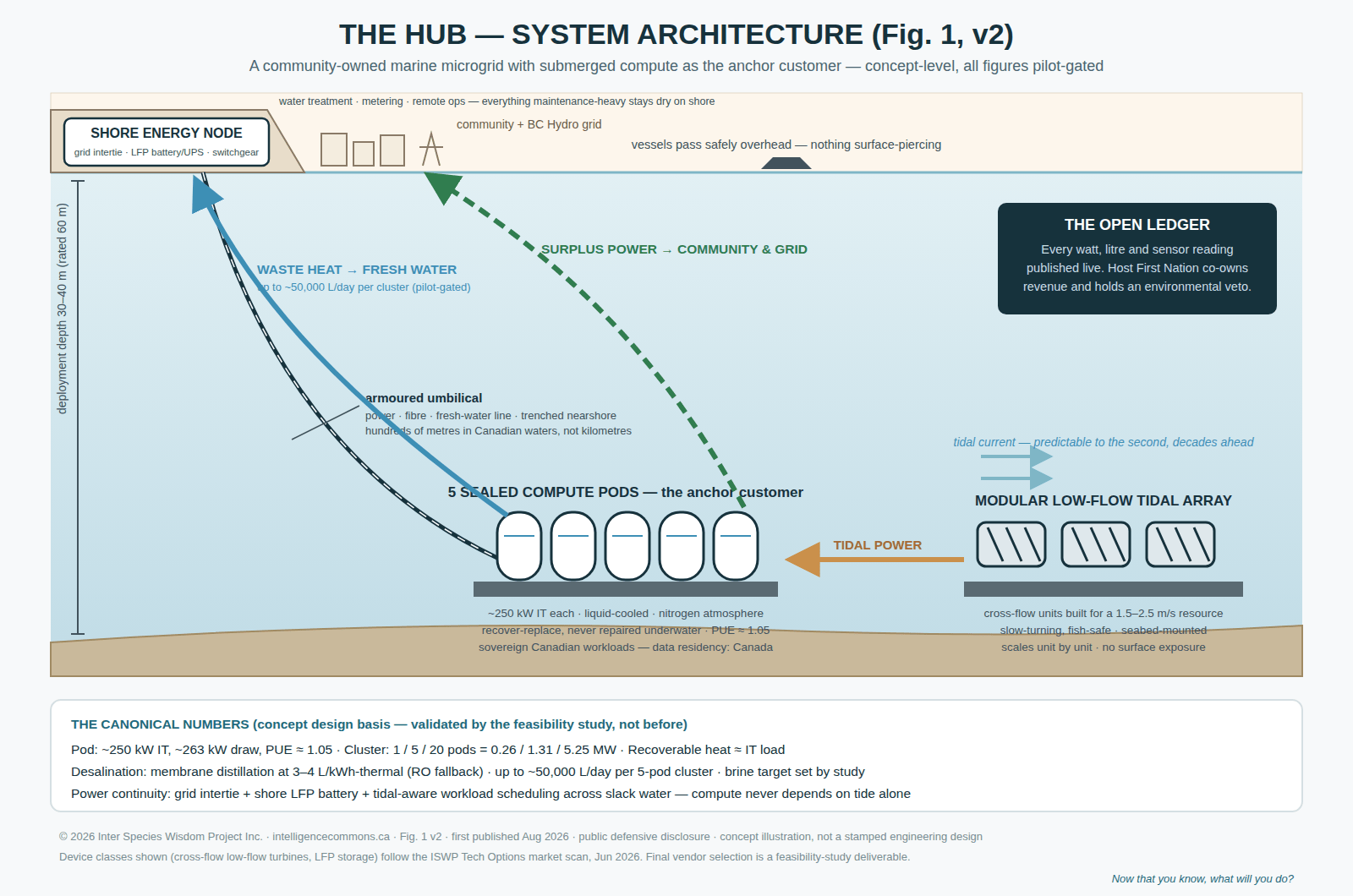
The Hub is engineered as a marine microgrid, not “a data centre with a turbine.” Four subsystems:
Shore energy node. Grid intertie, LFP battery/UPS, switchgear, protection, revenue metering, water treatment and remote operations. Everything maintenance-intensive stays dry, accessible, and off the seabed.
Marine generation. A modular array of low-flow tidal units on the seabed – device classes matched to a 1.5-2.5 m/s resource (cross-flow turbines, whose published rated points begin inside that band; a tethered tidal kite, engineered from 1.2 m/s up, is the carried alternative). Slow-turning and fish-safe, with the sector’s strongest independently documented fish-interaction record in the primary device class. Nothing pierces the surface; vessels pass overhead.
Compute fleet. Sealed, liquid-cooled, nitrogen-atmosphere pods on a shared frame (Section 4) – the anchor customer whose 24/7 load makes the tidal array financeable.
Network node. Short armoured umbilical – power, redundant fibre, and a fresh-water line – trenched nearshore, hundreds of metres inside Canadian waters, not kilometres of exposed international cable. LEO satellite as tertiary control path.
Power continuity is the crucial refinement. Tides reach slack four times a day; compute cannot. Continuity is layered: grid intertie + shore battery ride-through + tidal-aware workload scheduling – batch and deferrable work rides the tide, critical work rides the grid and battery. The scheduler that converts tidal variability from an energy problem into a compute-scheduling asset is identified as potential core IP (Claims register, Section 12).
4. The sealed compute pod
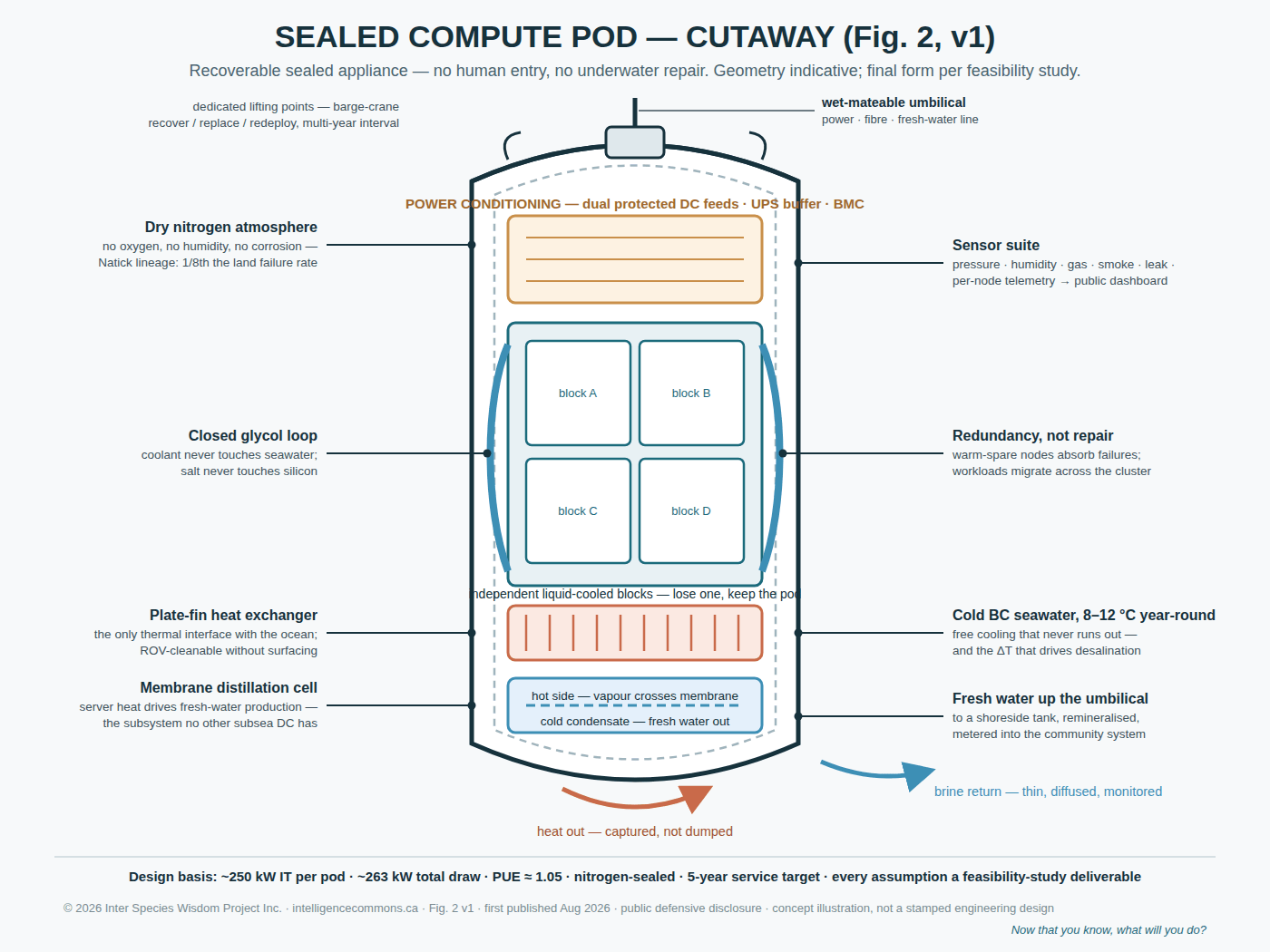
Each pod is a recoverable sealed appliance – no human entry, no underwater repair, designed for barge-crane replacement on a planned multi-year interval.
Shell and atmosphere. Pressure-optimized marine enclosure, corrosion-resistant structure, cathodic protection, non-toxic growth controls. Dry nitrogen interior at ~1 atm: no oxygen, no humidity, no biological contamination – the Natick lineage that produced the 1/8th failure rate. Pressure, humidity, gas, smoke and leak sensors throughout; wet-mateable power and fibre connections; ROV-readable external status.
Two-loop cooling. A closed glycol/water inner loop cools the electronics; a plate-fin heat exchanger bonded to the shell is the only thermal interface with the ocean. Seawater never touches silicon; salt never finds a corrosion path inside; biofouling is confined to an external surface an ROV can clean without surfacing the pod. The geometry is forward-compatible with two-phase immersion cooling without re-plumbing.
Independent compute blocks. Several liquid-cooled blocks with dual protected DC feeds, segmented distribution, redundant low-speed pumps, and isolated rack loops. Losing a rack, pump, power module or network path degrades the pod; it does not kill it. Failed hardware is simply left offline – workloads migrate to warm-spare capacity in the same pod or across the cluster. Redundancy, not repair.
Heat capture, not heat dumping. Below the exchanger sits the membrane-distillation cell (Section 7): the served heat drives fresh-water production before rejection. This is the subsystem no other subsea data centre on Earth carries.
“Hot-tub-sized” remains a communications image, per the v1 blueprint: final rack density, vessel geometry, service interval and lifting requirements are feasibility-study deliverables, and a 250 kW IT load may require a larger or differently shaped enclosure.
5. Tidal generation – 2026 technology options
The site reality governs everything. Power scales with the cube of current velocity: at 2 m/s a device makes roughly a third of its 2.9 m/s nameplate. A 1.5-2.5 m/s band therefore rules out the big open rotors designed for 3+ m/s straits and pushes selection toward devices engineered for slow flow. Resource characterization (in-situ current survey) is the make-or-break first deliverable of the feasibility study.
From the June 2026 market scan (full scan in the companion Tech Options Brief):
| Class | Exemplar | Why it fits | Caveat |
|---|---|---|---|
| Cross-flow / low-flow turbine (primary) | ORPC RivGen class (40-80 kW/unit) | Published rated points of 40 kW at 2.25 m/s and 80 kW at 3.5 m/s, so rated output begins inside the stipulated band and falls steeply below it (power scales with the cube of velocity); the manufacturer states its modular variant is designed for lower-velocity sites; seabed-mounted; slow-turning, low-acoustic; zero observed fish injuries over hundreds of monitored hours (DOE/Tethys-referenced); financed Canadian footprint | Modest unit power → array of units (suits the modular cluster) |
| Tidal kite (secondary) | Minesto Dragon class (100 kW-1.2 MW) | The one device class explicitly engineered for ~1.2 m/s+; grid-connected at national scale since 2025 | No Canadian presence; tethered flight adds complexity |
| Seabed modular (watch) | Nova Innovation M100D | Shetland array generating since 2016; permitted Canadian project | Rated-flow spec unpublished |
The scan’s most striking finding is vendor-bankruptcy risk: multiple tidal vendors exited or folded 2023-2024. Vendor diligence – financed, Canadian-present, low-flow, fish-safe – is a named study deliverable, and the reason no vendor is committed in this document. Indicative sector economics: ~$4-10k/kW installed; small-array LCOE ~$250-330/MWh today trending toward ~$110-165 by 2030; realistic first deployment 2-4 years, gated by permitting and interconnection.
6. Compute stack – what the Hub sells
Not training. A single modern training rack draws ~120 kW+; training wants hundreds of contiguous megawatts, tolerates failure only because humans swap nodes (impossible sealed), and chases the cheapest power on Earth. The Hub does not play that game.
Inference, edge and sovereign workloads are latency-sensitive, sovereignty-sensitive and price-tolerant – exactly where a BC-coastal sealed pod is structurally competitive. A sealed pod is frozen on its silicon for the service interval, so the stack favours efficient, proven, purchasable parts:
- Workhorse tier: mature ~350 W inference accelerators (hundreds per pod) plus ~72 W edge cards for light civic tasks – low-risk, sourceable, CUDA-mature.
- Sovereign tier: Canadian-designed accelerators (Toronto-HQ’d Tenstorrent class: purchasable, open-source stack, no allocation gating) making the Canadian-sovereignty story literal – with the honest caveat that fabrication remains offshore; design/software sovereignty is real, supply-chain sovereignty partial.
- Hosts: high-core-count, low-watt ARM/x86 CPUs for CDN/general workloads.
Bonus of the low/mid-power choice: moderate per-card heat flux eases the plate-fin exchange and yields exactly the steady low-grade (~40-60 °C) heat the desalination loop wants.
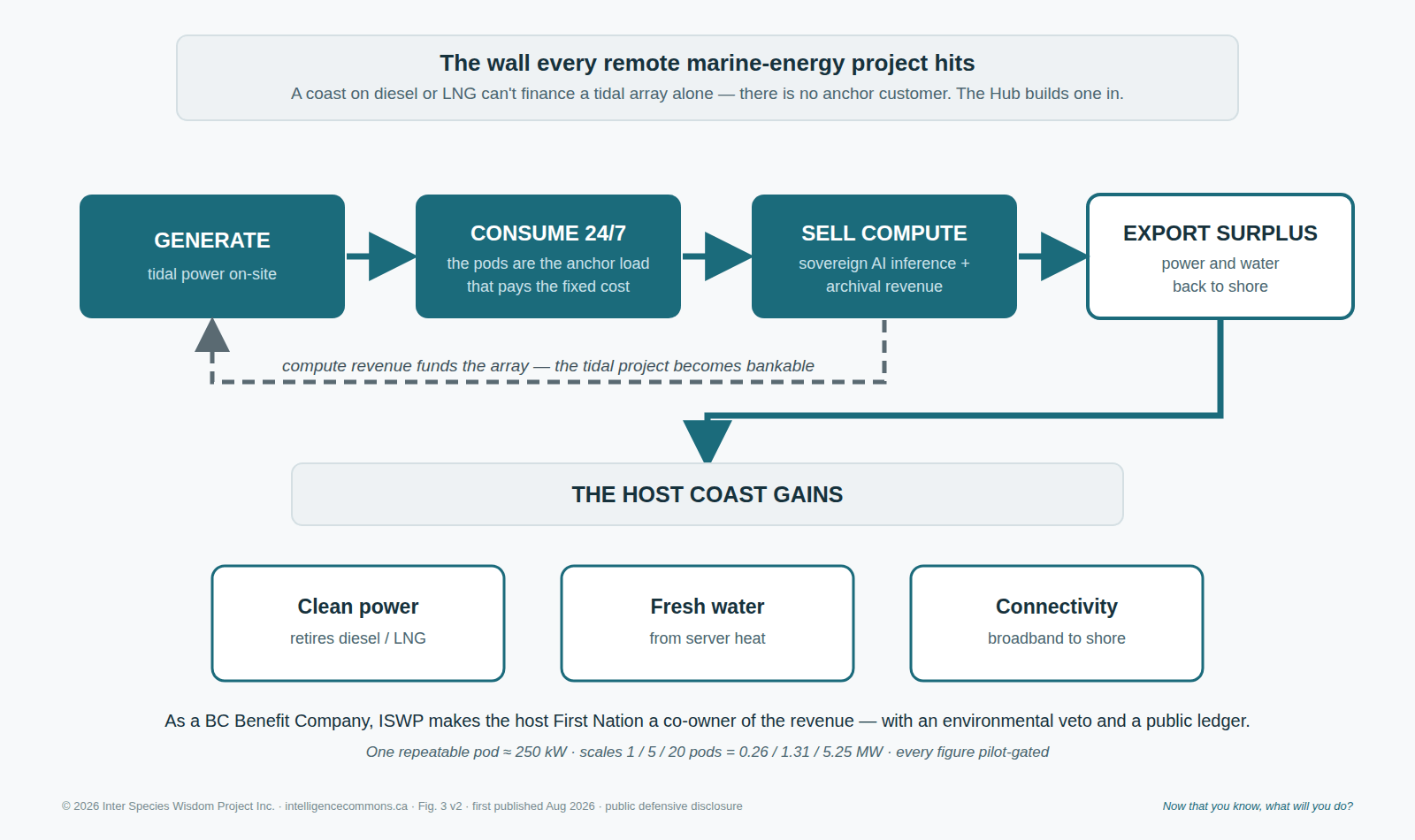
Anchor customer: the Intelligence Commons’ own civic-AI inference – ISWP is its own first tenant, eliminating launch-customer risk for the pilot. Candidate Phase-3 anchors: federal sovereign-residency inference, grid-side AI, Canadian academic research compute, edge-zone partnerships.
7. Waste-heat desalination – the structural differentiator
Membrane distillation (MD) is the only desalination method that natively consumes 40-55 °C low-grade heat in a small, modular, corrosion-tolerant marine package: hot loop on one side of a hydrophobic membrane, cold-condensate on the other; vapour crosses, salt stays.
Honest engineering posture, corrected from v0:
- Design to 3-4 L/kWh-thermal, not the 5 L/kWh warm-feed stretch figure. At a true ~45 °C source over an 8-12 °C sink, low flux means more membrane area – that capex trade is the central design question, and the pilot budget carries a dedicated MD validation line item.
- Carry waste-heat-preheated reverse osmosis as the TRL-9 fallback. If MD yields disappoint at real temperatures, preheated RO still uses the heat and ships off-the-shelf today.
- Resolve the brine recovery target early (10% recovery ≈ +1.1× salinity, trivially dispersed; 50% ≈ 2×, benign with a multiport diffuser and tidal flushing – but the two differ an order of magnitude in diffuser design). Confirm genuine deep-water exchange at any sill-restricted site by CTD survey before committing.
- Split the heat budget deliberately – the same cold seawater is both cooling sink and desal condenser; the study owns the allocation.
- Product water is near-distilled and is remineralised shoreside to potable standards – a standard polish step – then metered into the community system.
Adsorption desalination (which co-produces cooling) and the seawater battery (Section 8) are carried as Phase-3 research tracks, not near-term components.
Why it matters: the reference coastal BC water system reached Stage 4, its most severe drought stage, in three consecutive summers – 2021, 2022 and 2023 – and its supply has not been structurally changed since, while every data centre on the continent throws its heat away. Turning server heat into metered community fresh water is genuine white space – no operating or announced subsea data centre does it – and it is the structural answer to why the Hub belongs on a Canadian coast rather than in international waters.
8. Storage – LFP now, seawater battery as research
Phase-2 pick: LFP (lithium iron phosphate), shore-housed. The most mature, safest lithium chemistry – cobalt/nickel-free, thousands of cycles, proven marine deployments – and the only bankable choice today for ~600 kWh-class slack-tide ride-through. Housing it in the shore energy node removes marine-enclosure risk entirely.
Phase-3 research track: the seawater battery (UNIST lineage): seawater itself as the sodium source, non-flammable by construction, and it desalinates as it charges – thematically perfect for a submerged, water-producing, First-Nations-territory installation. Blocker is readiness (~TRL 4-5; membrane cost and seawater fouling). Fouling behaviour in cold BC water is precisely the kind of question a funded study can own with an academic partner. It is disclosed here as a research direction, deliberately not promised as a component.
Sodium-ion (commercial dry-cell, not yet marinized) is the middle option on watch.
9. Governance – the moat is legibility
- Host First Nation ownership: the Nation owns the site-bound assets through a site company it controls, holding not less than 50.1 percent, and is paid a first-priority share of gross revenue, off the top, for the operating life of any cluster on the Nation’s territory – the owner, not a CSR beneficiary. ISWP is the developer, paid a developer’s share of distributable cash, and holds no shares (restated September 15, 2026; terms on the Hub page). The same template stands offered to every Nation along the BC tidal corridor; non-participation simply means the Hub doesn’t build there.
- Environmental veto: the Nation can trigger a deployment audit at any time on environmental grounds; a confirmed concern forces operational change, up to decommissioning.
- The open ledger: power, thermal, water, compute and environmental telemetry published live; annual marine-biology and acoustic reports; a jointly approved quarterly report card. The inverse of closed-source subsea instrumentation – the Hub can be inspected, verified, audited and trusted, because a BC Benefit Company can afford to be legible.
- Data sovereignty: residency Canada, jurisdiction BC, foreign strategic equity excluded by charter.
10. Comparison – the category is empty
| Dimension | Natick (Microsoft) | Highlander/Hicloud (China) | Panthalassa | The Hub |
|---|---|---|---|---|
| Status | Research, retired 2024 | Commercial 2023+ | Pre-commercial | Concept → funded study → pilot |
| Power source | Land grid | Grid + wind | Wave | Tidal + grid + battery |
| Heat | Dumped to ocean | Dumped to ocean | Dumped to ocean | Captured → fresh water |
| Telemetry | Published research | Closed | TBD | Fully public ledger |
| Community return | None | None | None | Power + water + revenue share |
| Indigenous ownership | None | None | None | Nation-owned + veto |
| Cable exposure | Short | Short | Long international | Short, Canadian waters |
| Data sovereignty | UK | China | International/US | Canada |
Sealed subsea compute: proven. Commercial subsea compute: operating. Community-owned, heat-recycling, Indigenous-co-governed subsea compute: nobody. That category is the Hub’s.
11. What the funded study owns (conceded openly)
- In-situ tidal resource survey – the cube law makes this the make-or-break number.
- MD yield at a true ~45 °C feed; membrane-area sizing; RO fallback decision.
- Brine recovery target and CTD survey for deep-water exchange.
- Tidal vendor diligence: financed, Canadian-present, low-flow, fish-safe.
- Sealed-pod silicon lock (the multi-year freeze makes this a one-shot decision).
- Pressure-vessel geometry, service interval, and lifting/recovery engineering.
- Biofouling rates on the external exchanger in BC water.
- Acoustic and ecological baseline, then continuous monitoring.
- Seawater-battery fouling in cold BC water (Phase-3, academic partner).
- End-of-life decommissioning and materials-recycling protocol.
Conceding what is not yet known is a strength in front of engineers: each open question above is a work package that removes a reason the next funder could decline.
12. CLAIMS REGISTER – the defensive disclosure
The following combinations are hereby disclosed publicly by Inter Species Wisdom Project Inc., first published August 2026 with the version history on page 1, as prior art. Prior work is acknowledged where it exists; the claims are the combinations, which the named prior work does not practice.
Claim 1 – Heat-to-water subsea compute. A submerged data-centre pod whose rejected server heat drives on-board or co-located low-grade thermal desalination (membrane distillation or equivalent), with product water delivered to shore through the service umbilical and metered into a community water system. Prior art acknowledged: sealed subsea compute (Natick), commercial subsea compute (Highlander); neither recovers heat for water production.
Claim 2 – Tidal-aware workload scheduling. Operating a marine-powered compute installation by scheduling deferrable computation against the astronomically predictable tidal-generation curve – batch work rides the tide, critical work rides storage and grid – such that generation variability becomes a scheduling input rather than solely a storage problem, including the fleet operating platform that dispatches across pods and sites on this basis.
Claim 3 – Anchor-customer marine microgrid. Financing structure in which submerged compute constitutes the guaranteed 24/7 anchor load that renders a community-scale tidal array bankable, with surplus power, fresh water and connectivity delivered to the host coast as structural outputs of the same installation.
Claim 4 – Indigenous co-governed open-ledger infrastructure. Governance architecture for marine compute infrastructure in which the host First Nation holds a perpetual revenue share and a standing environmental veto, and in which operational telemetry (power, thermal, water, environmental) is published live as a public ledger, as chartered obligations of a benefit corporation rather than contractual promises.
Claim 5 – Recover-replace pod fleet. A fleet operating model for sealed seabed compute in which pods are never serviced underwater but recovered, refurbished and redeployed on planned intervals via standardized mechanical, power, fibre and water interfaces, with workload migration absorbing hardware failure between intervals.
Anyone may build on these disclosures; no one may now patent them out from under the communities they were designed for. That is the point of publishing them.
13. Source lineage
This master consolidates: Pod Prototype Design v0 (May 12, 2026) · Tech Options Brief – 2026 market scan (Jun 29, 2026) · Technical Blueprint v1 (Jul 30, 2026) · the Hub concept briefs and feasibility-study scope documents of June-July 2026. Full market-scan citations (vendor specs, DOE/Tethys fish-interaction monitoring, Natick reliability publications, desalination literature) live in the Tech Options Brief and are incorporated by reference.
Concept-level publication. Not an offer of securities, not a stamped design, and not a partnership announcement; no external partner named here has been engaged unless separately and publicly confirmed.
© 2026 Inter Species Wisdom Project Inc. · intelligencecommons.ca · Master Blueprint v2 · Public defensive disclosure
Now that you know, what will you do?
Correction: August 25, 2026
An earlier version of this page described the primary cross-flow device class as purpose-built for 2.25-3.5 m/s, and elsewhere described the device classes as purpose-built for a 1.5-2.5 m/s resource. Both statements were wrong, and they contradicted each other.
The figures 2.25 m/s and 3.5 m/s are two published rated-output points for the device – 40 kW and 80 kW respectively – not a design or operating band. The manufacturer currently describes its modular variant as designed for lower-velocity sites. The text above has been corrected to say what the published figures actually are. The stipulated siting envelope for Hearing #6 is unchanged: a tidal resource band of 1.5 to 2.5 m/s.
Found and corrected by the Commons before Round 1 of Hearing #6 published. Recorded here under the practice this Commons publishes: every error found, by anyone, recorded and dated, forever.
Revision, August 26, 2026: scale ladder published, turbine band corrected, heat flux published
Filed the same day as the Correction and Narrowing of Claim in Hearing #6, and consistent with it. The Hearing found six errors in the published Direct; four of them touch this document.
1. Scale ladder, published with its array counts. The blueprint has always listed 1 / 5 / 20 pods as design intent. It has never published what each step costs in generating units. It does now, at an assumed 70 kW installed capacity and a 40 percent tidal capacity factor, or roughly 28 kW average per unit:
| Step | Pods | IT load | Total draw | Array to match | Array to export 20 percent |
|---|---|---|---|---|---|
| Pilot | 1 | 0.25 MW | 0.26 MW | ~10 units | ~12 units |
| Commercial step | 5 | 1.25 MW | 1.31 MW | ~47 units | ~56 units |
| Design ceiling | 20 | 5.0 MW | 5.25 MW | ~188 units | ~225 units |
The array, not the pod, is what limits Hub scale. At the upper steps the array is very likely larger than the ecological ledger can carry as currently argued. Whether those steps are reachable is decided by the in-situ resource survey, already listed here as funded-study item 1 and already described as the make-or-break number. That description is now load-bearing.
2. Turbine band corrected, in our own favour. This document described the RivGen class as “purpose-built for 2.25-3.5 m/s.” That is wrong. Those are published rated-output points, not a design band. The documented Igiugig deployment operates in a mean flow of roughly 1 to 2 m/s at 70 kW installed capacity (Tethys/PNNL, verified August 26, 2026). The device is a better fit for the stated 1.5-2.5 m/s siting envelope than this document claimed. The August 25 revision fixed the sentence’s internal contradiction and left the device-fit statement wrong; this revision fixes it.
3. Local wake effect, disclosed. The same source records mean flow at Igiugig reduced from 2 m/s to 1 m/s at the device, recovering approximately 100 metres downstream. For one unit this is a small local wake. For an array it is simultaneously a spacing constraint on generation and an ecological question, and it is added to the resource survey’s scope.
4. Heat rejection, computed and published for the first time. A pod rejects approximately 263 kW into an 8-12 C sink.
| Natick Phase 2 (published) | Pod at “hot-tub” geometry | Pod at Natick-class flux | |
|---|---|---|---|
| Heat rejected | 240 kW | ~263 kW | ~263 kW |
| Hull | 12.2 m x 2.8 m | 2.2 m x 0.9 m | approx. 13.5 m x 2.8 m |
| External area | ~120 m2 | ~14 m2 | ~130 m2 |
| Flux | ~2.0 kW/m2 | ~19 kW/m2 | ~2.0 kW/m2 |
At a 30 K exchanger-to-sea difference, 19 kW/m2 requires an overall coefficient near 630 W/m2K. External forced convection on a 2.2 m cylinder at 2 m/s gives roughly 2,500 W/m2K (Churchill-Bernstein, seawater at 10 C). At slack water, four times daily, free convection on the same cylinder gives roughly 680 W/m2K (Churchill-Chu) – the requirement with no margin, before shell conduction and the internal side. Slack water, not peak flow, is the binding thermal case. Enclosure geometry and heat-exchanger area therefore remain a feasibility-study deliverable, and the phrase “hot-tub-sized” remains what this document already called it: a communications image, and never a specification.
5. Node counts remain retired. Retired here on August 13, 2026. A node count reinstated in the Hearing #6 Direct on August 25 has been withdrawn there as of August 26. 250 kW IT per pod is the published primitive. Node count is a quotient of a silicon lock listed here as a feasibility-study deliverable, and it does not publish before that lock is made.
Unchanged and unaffected: Natick reliability evidence, the desal yield of 3-4 L/kWh-thermal, LFP storage, the 30-40 m deployment depth design-rated to 60 m, the community ownership structure, and the funded-study list.
Revision, September 15, 2026: ownership language restated
Filed two days after the Hearing #6 Finding and recorded in the docket’s corrections log the same day. This document, the claim as filed and the Finding all described the host First Nation as a “co-owner” paid a share of revenue. The published position since early September is stronger and supersedes it: the host Nation owns the Hub through a site company it controls, holding not less than 50.1 percent and paid first, off the top; ISWP is the developer, paid a developer’s share of distributable cash, and holds no shares. Three passages above (the opening summary, Section 9 and the comparison table) are reworded to match. The full terms are on the Hub page. Nothing else in this document changes.